The Short Answer, by How Long It Sits
We test a lot of batteries in driveways and work lots around Milwaukee. The question we hear most after a cold snap is some form of "it only sat for a few weeks." So here is the short version, for a car with a battery under three years old that is fully charged when you park it.
| Time parked | What to expect |
|---|---|
| Up to 1 week | Starts fine. No action needed. |
| 2 to 4 weeks | Usually starts. In winter, check the voltage or plan a 30 minute drive. |
| 1 to 2 months | May start, may not. Many cars land here. Use a maintainer. |
| 2 months or more | Plan on a weak or flat battery unless it was on a maintainer. |
| Battery 3+ years old, or any time below 0°F | Move up one row. Old batteries and deep cold both shorten the window. |
Those ranges match what the battery makers say. Interstate Batteries (revised October 8, 2026) puts it at about four weeks to two months before a sitting battery dies. J.D. Power (February 9, 2023) says about two weeks for a new battery in good shape. Optima (February 21, 2022) says a new, full battery kept at a steady room temperature could last several months or more.
Why do the numbers spread from two weeks to several months? Because none of them say what sets the clock. The next section does.
The Math Nobody Shows You
A parked car is never fully off. The alarm, the keyless entry receiver, the clock and the computers that remember your settings all sip a little power. Mechanics call it standby draw, or parasitic draw when it is too high.
What counts as normal? GM's service bulletin for technicians, TechLink (December 21, 2020), says the reading should settle under 20 milliamps about 10 minutes after the car is locked, and to start hunting for a fault at 40 milliamps or more. A Snap-on guide in Vehicle Service Pros (December 5, 2022) uses under 50 milliamps as the guide, and notes that a module left powered on can pull as much as 150.
Now the battery side. Battery size is listed in amp hours. For example, one Group 35 battery, a common size, is listed at 65 amp hours in this Continental EFB listing. Sizes vary by brand and model, so check the label on yours.
Here is a worked example with a 60 amp hour battery, a round number a little under that one. Battery Council International says to recharge a stored battery once it drops below 12.4 volts, per the Trojan Battery storage guide (2012). On that guide's chart, 12.4 volts is about 70 to 75 percent full. To keep the math simple and on the safe side, call it a quarter of the battery. That is 15 amp hours the car can use before it needs a charge.
Days parked, 60 amp hour battery
Dark bar: days until it needs a charge (12.4 volts). Light bar: days until half charge.
20 mA, a car that sleeps well
50 mA, the top of normal
150 mA, a module that stays awake
That one chart explains the whole spread online. A car that sleeps at 20 milliamps gets a month. The same car with a glove box light stuck on, a dash cam on a constant feed or a module that never goes to sleep gets four days.
Older batteries hold less to start with. Interstate says that if your battery is three or more years old, a long sit could be the end of it. Less starting capacity means every number in the chart gets smaller.
Why a Milwaukee Winter Changes the Answer
Cold does two things to a parked car, and they pull in opposite directions.
First, the good news. Cold slows the battery's own self drain. The Trojan storage guide shows a battery at 42°F losing charge about three times slower than one at 75°F. That is why a battery can seem fine in a cold garage for weeks.
Now the bad news. Cold cuts what the battery can deliver right when the engine needs more. AAA's Car Doctor John Paul told AAA Northeast (December 29, 2025) that an engine needs about 30 percent more energy to start at freezing, and that at 0°F a battery can only deliver about half its rated capacity. A battery at 70 percent might crank a car in October and fail to on a January morning.
And the part almost nobody mentions. A low battery can freeze. The water in the battery acid freezes at a higher temperature as the charge drops. Here is the Battery Council International table, as printed in the Trojan guide, next to Milwaukee's weather.
| State of charge | Freezes at | In Milwaukee |
|---|---|---|
| 100 percent | −92°F | Safe. Colder than any Milwaukee record. |
| 85 percent | −62°F | Safe. |
| 62 percent | −16°F | At risk on a record cold night. |
| 40 percent | +5°F | At risk most winters. December and January both dip below this. |
| 20 percent | +19°F | At risk on an average January night. |
The Milwaukee side comes from the NOAA 1991 to 2020 normals for Mitchell Airport in the Milwaukee climate table. The average January low is 17.2°F. The coldest night of a typical January drops to about −4.5°F, and of a typical December to about 3.2°F. The record lows are −26°F.
AAA Northeast gives the same warning in plain terms. A fully discharged battery, just under 12 volts, can freeze at 32°F. A frozen battery is done. The Trojan guide says freezing usually does damage that cannot be repaired, and it warns that wind can freeze a battery that would not freeze in still air.
So in Milwaukee from December to February, "how long before it dies" is the wrong question. The real question is how long before it gets low enough to freeze. For a car parked outside, that point comes well before the battery is flat.
Check It Yourself With a Basic Meter
You do not have to guess. A basic digital multimeter tells you where the battery stands. Measure after the car has sat overnight, not right after a drive.
- Set the meter to DC volts, the 20 volt range.
- Red lead on the battery's plus post, black lead on the minus post.
- Read the number and find it in the chart below.
| Volts | Charge | What to do |
|---|---|---|
| 12.7 or more | Full | Nothing. |
| 12.6 | About 90 percent | Fine. |
| 12.5 | About 80 percent | Fine, but watch it in winter. |
| 12.4 or less | About 70 percent | Charge it now. |
| 12.1 | About 50 percent | Charge it today. Freeze risk on a deep cold night. |
| Under 12.0 | 40 percent or less | Charge it, then have it load tested. |
The volts come from the per cell voltages in the Trojan storage guide, times six cells. AGM batteries read a little higher at the same charge, so check your battery maker's chart if yours is AGM.
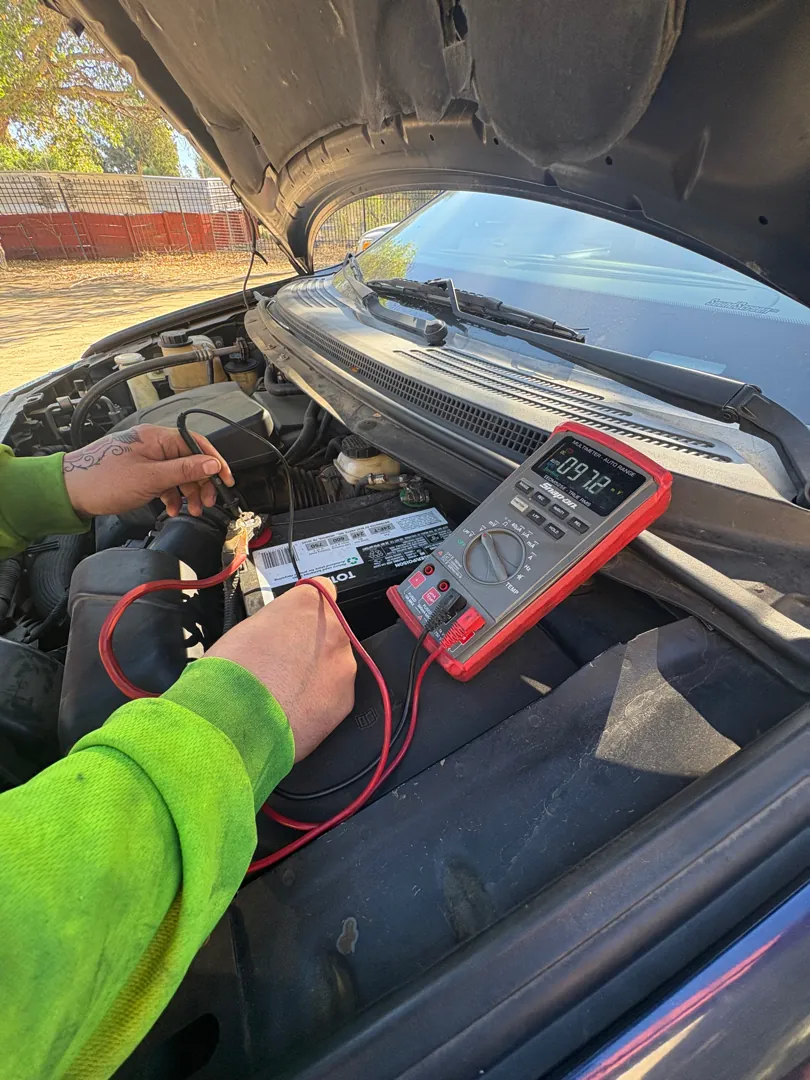
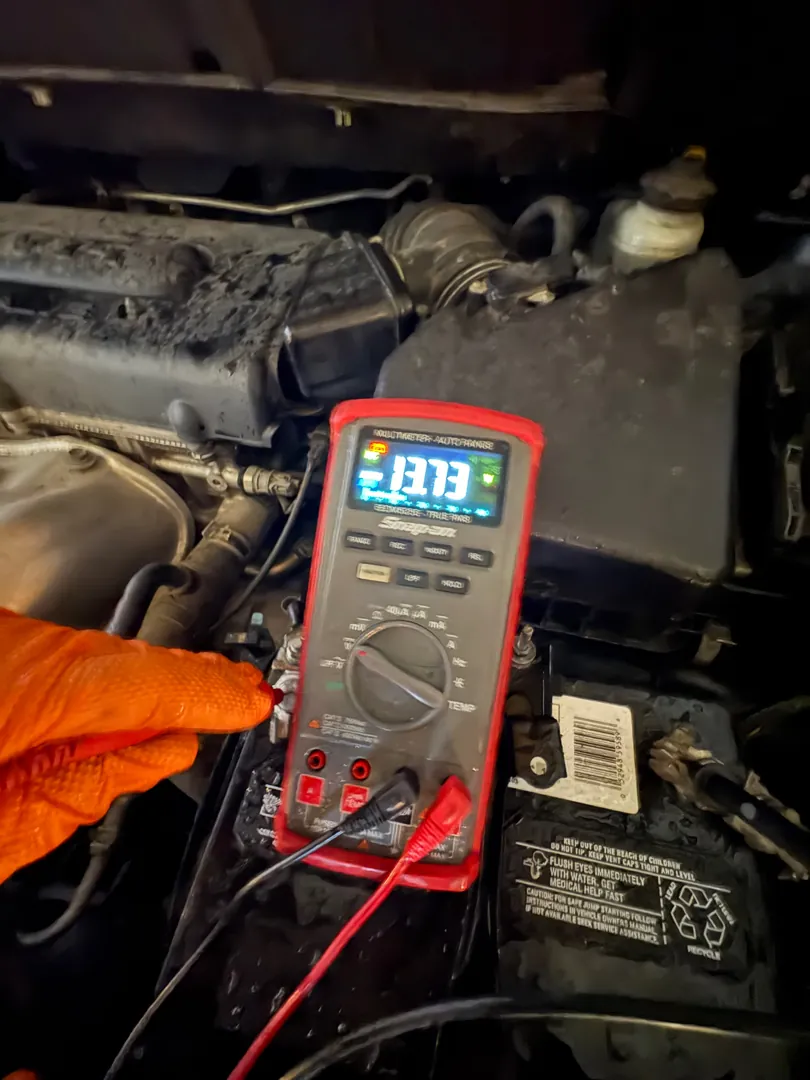
One reading is not a verdict. Voltage tells you charge, not health. A battery can show 12.6 volts and still fail under load. That is why we load test and check the charging system before anyone buys a battery. More on that on our battery and starting page.
How to Park a Car Without Killing the Battery
Pick the line that fits how long the car will sit.
- Under two weeks. Do nothing special. Make sure every light, the dash cam and any phone charger is off.
- Two weeks to a month. Drive it once a week. Interstate says at least 30 minutes at highway speed. A short idle in the driveway is not the same as a real drive.
- A month or more, or all winter. Use a smart battery maintainer, the kind that switches itself off when the battery is full. Optima says to fully charge a stored battery to at least 12.6 volts first. J.D. Power and Interstate both point to a maintainer for long sits.
- No outlet near the car. Disconnect the negative cable. Note that many newer cars lose radio presets and some need a relearn after that. A better plan for a street parked car is a fully charged battery and a voltage check every two weeks.
If the car died after only a few days, the battery is often not the problem. That points to a draw that is too high. Tracking it down means putting a meter in line and pulling fuses one at a time after the car falls asleep. GM's bulletin notes some cars take up to two hours to fully power down, which is why a quick test can miss it. Our diagnostic visits cover this.
When It Has Already Died
A jump will usually get it going. Then the work starts. A battery that has sat flat, especially through a cold snap, may not take a full charge again. Give it a long drive or a full charge on a charger, then test it at rest and under load.
If it was flat in freezing weather, look at the case before you jump or charge it. A bulged or cracked case means it froze. Do not jump it. Replace it.
And if it keeps happening, find out why before you buy a second battery. A battery that dies again in a week is telling you about the car, not the battery. Our no-start page walks through what a slow crank, a click and a dead silence each point to.
Milwaukee Mobile Mechanic tests batteries, charging systems and standby draw at your home or work. Call (414) 877-8092.
Sources
- Interstate Batteries, Can a Car Battery Die from Sitting Too Long? (revised October 8, 2026)
- J.D. Power, How Long Does a Car Battery Last Without Driving It? (February 9, 2023)
- Optima Batteries, Can a Car Battery Go Dead From Sitting? (February 21, 2022)
- GM TechLink, New Circuit/System Testing for Parasitic Draws (December 21, 2020)
- Vehicle Service Pros, Parasitic Draw Diagnosis From a Vehicle Battery (December 5, 2022)
- Trojan Battery Company, Deep-Cycle Battery Storage white paper (2012), citing the BCI Battery Service Manual
- AAA Northeast, Maintaining Your Car Battery in the Winter (December 29, 2025)
- Continental Battery, Group 35 EFB listing
- Climate of Milwaukee, NOAA 1991 to 2020 normals table